


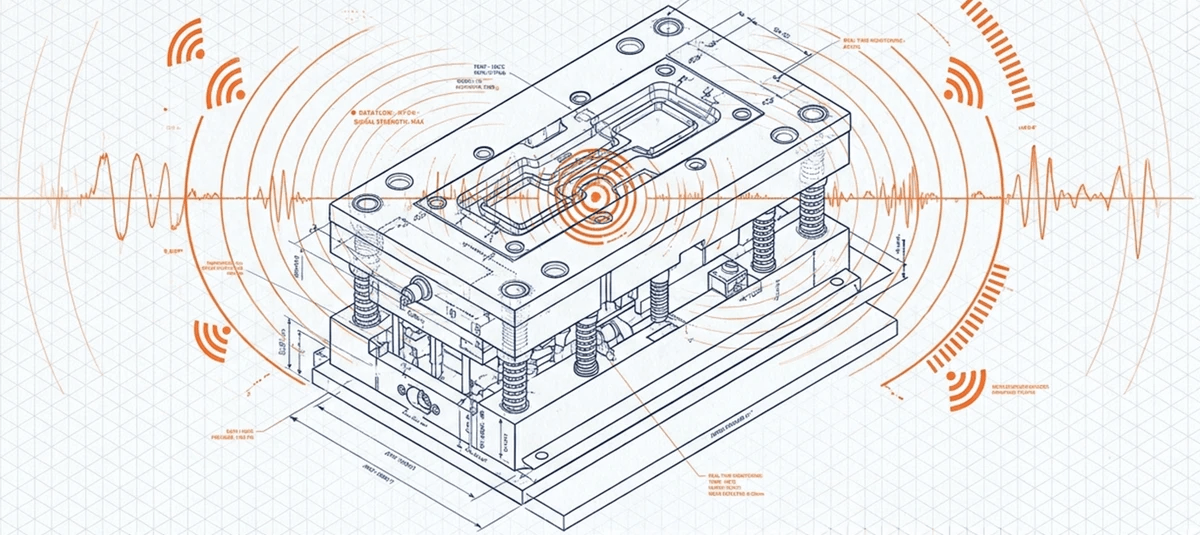
Hybrid Connectivity
Wired & Wireless Convergence
Legacy Plant Pain Points
The High Cost of Cabling & Core Pain Points

Spatial Constraints & Deployment Barriers
- Tight Line Footprints
Dense equipment layouts in legacy lines leave minimal physical clearance for routing new sensor cables.
- Labor-Intensive Routing
Legacy setups require continuous cabling from the sensor to the control cabinet—demanding extensive labor for drilling, mounting, and cable management.

High Maintenance Overhead & Zero Flexibility
- Complex Troubleshooting
Signal anomalies require technicians to manually trace physical cables across harsh shop-floor environments, severely increasing mean time to repair (MTTR).
- Rigid Infrastructure
Once hardwired, relocating monitoring points for process optimization forces a total re-engineering of cable pathways, eliminating operational agility.

Environmental Interference & Signal Integrity
- Electromagnetic Interference (EMI)
Long-distance analog cabling acts as an antenna for electromagnetic noise from high-power equipment and VFDs, distorting high-precision vibration data.
- Cable Jacket Degradation
Continuous exposure to extreme thermal loads, high humidity, and cutting fluids accelerates jacket embrittlement, triggering critical insulation failure and safety hazards.
The Pure Wireless Fallacy
Engineering value lies in solving operational bottlenecks, not in blindly chasing a cable-free aesthetic.

The Myth
Cutting Physical Cables Eliminates Maintenance Overhead
The Reality
- Power Management Strain
Recurrent replacement labor and battery disposal costs.
- Link Continuity Risks
Managing wireless uptime across hundreds of dense nodes outpaces legacy wiring upkeep.

The Myth
Wireless communication matches wired transmission in real-time latency and data throughput.
The Reality
- Signal Attenuation & Packet Loss
Industrial metal shielding and heavy EMI disrupt wireless deterministic latency.
- Throughput Limits in Critical Processes
Pure wireless bandwidth fails to guarantee the continuous, high-sampling-rate telemetry required for stable machine control.

The Myth
Wireless systems offer effortless, zero-configuration plug-and-play deployment.
The Reality
- Vulnerability to Dynamic Dead Zones
Systems lacking edge self-diagnostics and backfill buffering fail to counter unstable RF environments.
- Prolonged Data Vacuums
Communication dropouts lead to missing telemetry, compromising deterministic process visibility.
Strategic Convergence
Technical Specifications & Architecture Benefits

Strategic Short-Run Wiring
Digitizes signals at the source via ultra-short sensor-to-transmitter wiring, eliminating long-distance cabling bottlenecks.
- Multi-Hop Mesh Topology
Deploys multi-path mesh routing to bypass dense metal shielding and equipment obstructions, preventing single-point RF dropouts.
- High-Availability Deploymen
Eliminates shop-floor battery maintenance labor while bypassing facility-level structural drilling and retrofits.

Hybrid Data Link Architecture
Agile Configuration over Pure Wireless
- Versatile Hybrid Topology
Concurrent wired and wireless infrastructure tailored to operational demands.
- Wired : Dedicated wired connections for high-sampling-rate critical nodes to guarantee deterministic reliability.
- Wireless : Agile wireless deployment for high-frequency changeover and molding reconfiguration nodes to achieve maximum flexibility.
- Open Data Integration
Native integration with existing client architecture, spanning field-level Modbus to cloud-level APIs.

Smart Data Filtering
- Edge-Level Feature Extraction
Formulates real-time edge processing to transmit only critical features: a-Peak, a-RMS, v-RMS, and Temperature.
- Bandwidth Optimization
Minimizes RF network congestion and guarantees deterministic latency.
- Zero-Dropout Telemetry
Eliminates communication blind spots and data gaps.


